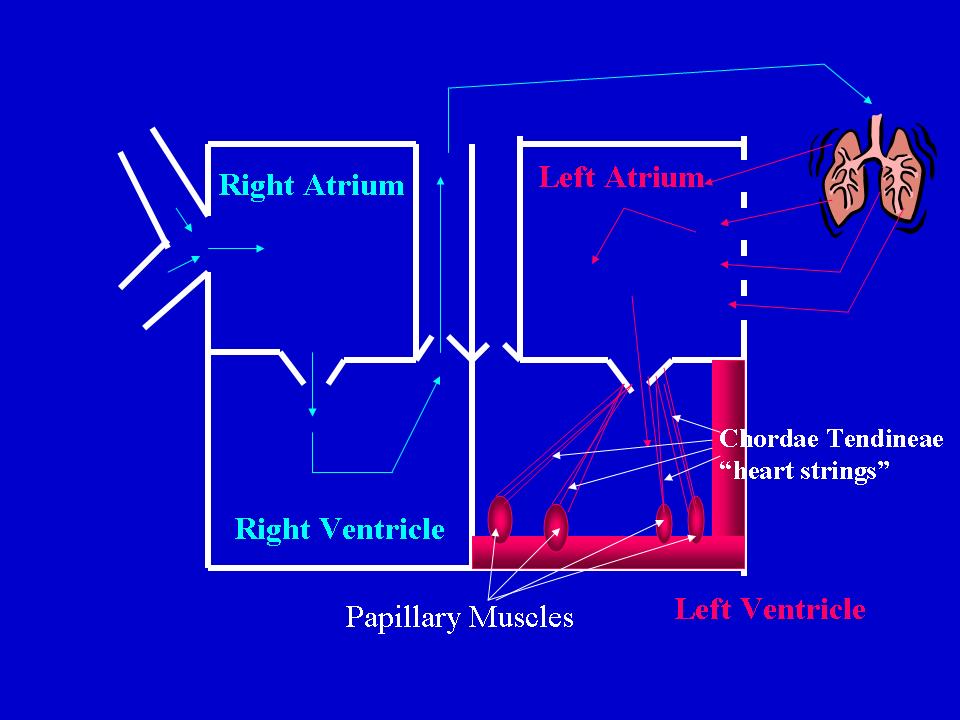
Because the left ventricle is the cardinal chamber of the heart
(responsible for systemic circulation), it must contract very forcefully.
As a result, there is a lot of wear and tear on the mitral valve.
The force of ventricular contraction can cause the AV valves to
prolapse, or flip back into the atria, and allow blood to backflow into
the atria. To prevent this, the cusps of the AV valves are attached
to little tendons known as chordae tendinae. These are attached
to papillary muscles in the ventricles. The papillary muscles
are "nipple" like projections of the myocardia and contract when the myocardia
contracts. As a result, they pull on the chordae tendinae and help
to prevent prolapsing of the AV valves. The chordae tendinae and
the papillary muscles occur in both the left and right ventricles.
I mention them here because they are so important in systemic circulation.
Also, most problems with valves in the heart involve the mitral valve.
It takes quite a beating.
Next Page Previous
Page First Page